The Stories behind our Designs
The Claddagh
Legend has it that the Claddagh symbol was originated by Richard Joyce, a Galway seafarer kidnapped by piates and sold into slavery in North Africa. Here, he learned the art of a goldsmith. When he was released, nothing could keep him from his beloved Galway where he returned to become a master goldsmith and where he created the Claddagh ring. For centuries this was used as a wedding ring by the fisher folk of Claddagh village, which nestled outside the walls of Galway City in the west of Ireland. Claddagh rings are worn as friendship, engagement or wedding rings depending on how they are worn.
Friendship: by placing the ring anywhere on your right hand.
Engagement: by placing the ring on the third finger of your left hand with the heart pointing outwards.
Wedding: by placing the ring on the third finger of your left hand with the heart pointing inwards towards your heart.
Celtic Knot & Celtic Cross
Celtic Knot Spirals have been found on ancient art on every continent, usually depicting the Sun. The Celts coming to Ireland would find spirals at Newgrange, carved into stone by Irish farmers, depicting the four journeys of the Sun around the Earth.
As they saw it, one stone having a Triskele of Spirals, thought to be a fertility symbol, or a symbol of rebirth as each journey of the Sun would take three months.
The Lover’s Knot design is attributed to sailors and seafarer’s who would weave the knot with two pieces of rope to give to sweethearts as mementos. This same knot was likely to adorn a Celtic Shield, the points of the square, a plea to the God’s of the four corners of the Earth for protection, also called ‘St. Hans Cross’ or ‘The Earth Square’.
Celtic Cross: Throughout Ireland and Scotland, the Celts crafted these magnificent symbols in stone. Celtic Crosses predate Christianity and were first used by pagans to worship the Sun. In pagan times the circle of the Celtic Cross represented the Sun, being the centre of their lives. It was not until the 4th century AD when it was introduced by the Roman Emperor Constantine, that the Celtic Cross was used to represent Christ’s victory. During the great conversion of many pagans to Christianity, Christian philosophers adapted the Celtic Cross and taught the meaning of the circle to represent Christ, the centre of Christianity.
Trinity Knot
Triqueta - predates Christianity and is the the Celtic symbol of Odin, Goddess of the North. Triplicities, Trickle (triple spiral), were common symbols in Celtic myth and legends. Because of this the Triqueta makes an ideal Christian symbol. It is also considered to represent the ‘three in one’ in Christian trinity beliefs, usually relating to the triplicities of mind, body and soul or alternatively; earth, sea and sky.
Ogham
Ogham script is an early form of old Irish, the first known Irish writing. The characters comprise a series of lines and notches that are scored across a long stem-line often on standing stones. In the majority of cases the inscription is read from the bottom up and usually names the person being commemorated along with their ancestors and the carver of the inscription. Over 350 Ogham stones are known, with the majority found in Southern Ireland from Kerry to Waterford and in South Leinster. They also occur in small numbers in western Scotland, the Isle of Man and in Cornwall at Lewannick, where Irish settlers from Munster landed and founded communities. While the stones in Ireland are written purely in Ogham, those in Britain often have the Ogham repeated in Latin and carved in Roman characters on the same stone. In legend Ogham was said to have been created by Ogma, the son of An Dagda. Ogma was both a warrior and the God of Eloquence and Literature. He fought the second battle of Magh Tuireadh where he slew the Formorian Indech, son of the Goddess Domnu.
The Celtic Warrior Collection
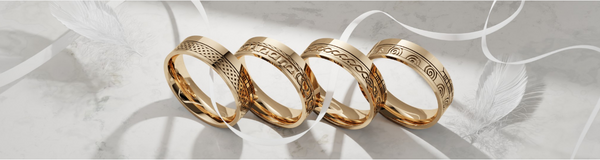
Our Celtic Warrior Collection is inspired by our famous Ardagh Chalice. The Ardagh Chalice is from the 8th century AD and is also one of Ireland’s most prized artifacts. The Chalice is located in the National Museum of Ireland. It’s one of the most important pieces of Celtic art. It’s from the ornate designs of the Ardagh Chalice that we have created our much loved Celtic Warrior Collection. The gold filigree on the Ardagh Chalice forms the basis of the intricate designs featured on each piece of our Celtic Warrior Collection.
Tree of Life
Many cultures, including the Celts, have a ‘Tree of Life’ or Crann Bethadh (in Gaeilge) concept. In today’s world, you can -find the Celtic Tree of Life on a wide range of items; it’s a popular tattoo request, looks excellent on tapestries, and makes a stunning necklace or pendant design, among other things. However, the Tree of Life was a significant symbol for the Celts and other ancient cultures. Branches that out and downward crown the sacred tree’s wide trunk. Its roots and branches are mirror images of each other, giving the motif a sense of balance and harmony. The Tree of Life symbol is, of course, associated with ancient Celtic culture, but also with nature and intergenerational ties. Consequently, different; Celtic jewelry;can represent the Tree of Life art in many different ways.
Moss Agate Stone:
Meaning
Throughout history, moss agate has been attributed with various symbolic meanings. These meanings range from improving one’s mental and emotional balance to enhancing one’s communication skills. The stone is believed to stimulate creativity and promote self-expression. It is also said to help one connect with nature and the earth providing grounding energy.
Moss agate is often used in meditation practices, as it is thought to bring a sense of calm and tranquility. Its green color is associated with growth and renewal, making it a popular choice for those seeking to manifest positive change in their lives.
Benefits & Healing Properties
Moss Agate offers holistic benefits, improving circulation, reducing stress, enhancing concentration, and promoting emotional balance. It fosters spiritual grounding, connects with nature’s energies, and stimulates the heart and throat chakras.
Physical:
The physical benefits of Moss Agate extend beyond its immune boosting properties, as it also aids in digestion, promotes cardiovascular health, and supports brain function. Its anti-inflammatory properties help soothe the digestive system, making it an ideal stone for those suffering from stomach issues. The stone also helps to regulate the heart and circulatory system making it beneficial for those with cardiovascular issues. Furthermore, Moss Agate has been found to help balance brain imbalances and support brain function.
Mental:
By promoting a sense of inner calm and stability, Moss Agate can help individuals manage their thoughts and cultivate a more positive mindset. This stone is known for its ability to balance energies, whether one tends to be overly nurturing or struggles with negative thoughts. Its green crystal healing properties work to soothe the soul and lift one’s self-esteem. Like a refreshing walk in nature or a restful nap in the grass, this stone reminds us to slow down and find balance in our hectic lives.
Emotional:
Moss Agate stone is trustworthy and fruitful for those who experience mood swings and emotional drama. It aids in controlling the mind’s temper and promoting tolerance, which leads to inner peace. Moss Agate helps in maintaining the right self-image and building positive character traits, leading to satisfaction and confidence. This stone is especially useful for those who struggle with depression, as it assists in gaining emotional balance and a more positive outlook on life.
Spiritual:
Wearing Moss Agate can connect one’s mind with nature and spirits, promoting spiritual development and providing a high level of commitment to our work. The green crystal is also known for inspiring reflection of life experiences and developing one’s spirituality as a personality development trait.
On top of that, Moss Agate is a “growth mineral” that contains powerful means from the Earth’s life forces, nurturing struggling family relationships or business-related schemes.
Chakra:
The moss agate stone is associated with the heart chakra, which is located at the center of the breastbone. Balancing this chakra can lead to improved decision-making abilities and stronger emotional reactions. The heart chakra is responsible for managing our inner souls and helping us to decide what is right or against us. With a balanced heart chakra, one can feel in control of their life decisions and relationships. Moss agate can aid in this balancing process, allowing individuals to feel more organized and in tune with their environment
Malachite Stone:
Malachite healing properties can help with physical, emotional, and spiritual balance and issues. It has healing powers to help with physical ailments and emotional issues. It is also used in Energy Healing and Chakra balancing. Malachite healing crystal therapies include regulating the menstrual cycle, helping with depression and anxiety, and drawing out the negative energy. The therapeutic uses of Malachite have a long and well-documented history. Meditation with Malachite is also highly recommended.
Arian Collection:
Arianrhod was the Goddess of the moon and stars. She is the Celtic Goddess of “Fertility, Rebirth and the Weaving of Cosmic Time and Fate”. The name “Arianrhod” is derived from the Welsh arian, “silver,” and rhod, “wheel” Her name has been translated as “Silver-Wheel”, a symbol that represents the ever-turning wheel of the year, a symbol of our own journey each year…
Solstice Collection:
Our Winter Solstice Pendant with Swirls and 18k Gold Bead is inspired by the Winter Solstice. The Winter Solstice is a Celtic celebration of the shortest day, and longest night, of the year. It is thought to be a period of quiet energy. This can allow you to take the chance to reflect on yourself and focus on what you want to achieve. The Winter Solstice is also a time to set goals and intentions for the coming year, examine and release your past and to make positive personal changes. Newgrange passage tomb is a UNESCO World Heritage Site, for one. It predates both the Pyramids of Giza in Egypt and Stonehenge in Britain Every year, many people travel to Newgrange, Co. Meath to view the Winter Solstice through the Newgrange passage tomb. The light from the rising sun, if visible, lights up the inner chamber of the 5,000-year-old passage tomb .The Newgrange passage tomb was built around 3200 BC, during the Neolithic period, making it older than Stonehenge; and the Egyptian pyramids. As the sun rises on the shortest day of the year, a ray of light breaks through a narrow slot at the entrance, illuminating the central chamber at the end of a sixty-foot-long tunnel. What happens there every year is described as a miracle. On the 21st of December 1967, Professor O’Kelly rediscovered the winter solstice phenomenon in Newgrange. It was the first winter solstice witnessed at Newgrange by anyone in over 5,000 years.
Shamrock:
A shamrock is a type of clover, used as a symbol of Ireland. Saint Patrick, one of Ireland's patron saints, is said to have used it as a metaphor for the Christian Holy Trinity. The name shamrock comes from Irish seamróg, which is the diminutive of the Irish word seamair and simply means "young clover".
Nuada:
Part of the Celtic Warrior® Collection, this Sword, Bangle and Ring of Nuada owes its name and design to the legend of King Nuada of Tuatha de Danann (‘the people of the goddess Danu’), the ancestors of the Irish. Nuada remains a famous figure in Celtic mythology, remembered for his peculiar weapon. This weapon was known as Claimh Solais, the Sword of Light. The sword of Nuada was one of the Four Treasures of the Tuatha de Danann. According to the lgend, no one could escape or resist the blade once it was taken from its sheath.
Damhsa "Dancing Stones".
Damsha is the Irish word for ‘dance’. This collection literally ‘dances’ with movement, creating a shimmering display. An array of styles can be found in the collection, including iconic Claddagh inspired pieces. The perfect Irish gift; your order will arrive beautifully presented in an individual Award winning presentation box.
St. Bridgets Cross
Along with St. Patrick, St. Bridget is one of Ireland’s most revered saints. Bridget founded a monastery in Co. Kildare in around the year 480 and she is also credited with founding a school of art which included metalwork and illumination. One of the most commonly told stories about Brigid is of her asking the King of Leinster for land The king laughed and refused, she smiled and said “will you give me as much land as my cloak will cover”? The king, thinking he would get rid of her, agreed. The cloak was spread to on the ground facing the four points of the compass and it began to spread and cover the land. In fear of losing all his land the king agreed to give her a descent plot of land and he eventually converted to Christianity. The cross named after the saint is said to have been made as she visited the deathbed of either her father or a local lord. Praying beside the bed the floor was strewn with rushes, as was the tradition at the time, and she picked up some rushes and formed the cross. The St. Bridget’s Cross has four arms tied at the ends of a woven middle square. The crosses are still made today by school children all across Ireland on her feast day, which is February 01. They are set over doorways and windows to keep homes from harm. It is given as a symbol of protection and love.
Harp:
The Harp was said to be invented by the goddess Cana Cludhmor, the Gaelic goddess fo dreams, inspiration and music. Legend has it that while walking on a beach one night she was lulled to sleep by beautiful music. Upon waking she realized the music had been created by the wind blowing through the sinews attached to a whale skeleton washed up on the shore, and this inspired the design of the harp.
Dagda, the god of fertility and agriculture, owned a magical harp made from oak and encrusted with jewels. He was the leader of the Tuatha Dé Danann, an ancient semi-divine race who ruled Ireland thousands of years ago. His harp summoned the seasons of the year when he played it. He brought it with him everywhere, and it flew to his hand when he summoned it. Those who heard him play were enchanted by one of three types of music he played—either to laugh with joy, cry with sorrow of fall into a deep sleep. This remains the basis of three types of tunes for the harp: Goiltai (laments), Geantrai (celebrations) and Suantrai (lullabies).